
| Configuration | Glass - Polymer |
| Colour | Red frame / Red background |
| Cell technology | TOPCon |
| Number of cells | 108 cells |
| Layout ratio | 0,199 kW/m² |
| Number of busbars | 16 Bus Bar |
| Dimensions | 1134 mm x 1722 mm |
| Frame thickness | 35 mm |
| Weight | 24 Kg |
| Cable length | 1.200mm |
| Snow load resistance | 750 Kg/m² |
| Hail resistance | HW5 (Ø45mm, 110Km/h) |
Monocrystalline TOPCon silicon photovoltaic module: 390 Watt, 108 cells. PRISMA 4.0 technology: 4 mm internal prismatic glass, front POE polymer with a density of 430 g/m³, transparent backsheet, red frames. Dimensions 1722x1134x35 mm, weight 24 kg, static load resistance 750 kg/m², hail resistance 45 mm at 110 km/h. 30-year warranty on manufacturing defects and 30-year linear performance warranty. Class 1 fire reaction, Class E certified, Broof (t2).
| Glass thickness | 4,0 mm |
| Glass composition | low-iron tempered |
| Glass type | internal prismatic |
| Nanotechnology treatment | ARC (Anti-reflecting-coating) |
| Solar transmittance | ≥ 93,8 % |
| Polymer composition | POE (Polyoxyethylene) |
| Polymer density | 430 gr/m² |
| Pmpp (Wp) | Vmpp (V) | Impp (A) | Voc (V) | Isc (A) | Prod. eff. (%) | Circuit eff. (%) | |
| TRS 390-54M-H8N ECO-RED | 390 Wp | 30,7 V | 12,71 A | 37,9 V | 13,54 A | 19,9 % | 24,5 % |
| Coefficiente Pmpp | Coefficiente Voc | Coefficiente Isc | NOCT | |
| TRS 390-54M-H8N ECO-RED | -0,30 % / °C | -0,25 V % / °C | +0,046 % / °C | 45°C ± 2°C |
| IEC 61215 - 2:2017 (ed.II) | TÜV SÜD |
| IEC 61730 - 2:2018 (ed.II) | TÜV SÜD |
| PID / Salt Mist / Ammonia | TÜV SÜD |
| Reazione al fuoco:Classe 1 (UNI 917A)Broof (t2) EN-13501-5:2016Classe E EN-13501-1:2018 | Istituto Giordano |
| PRISMA 4.0 technology | University of Brescia |
| ISO 9001:2015 Quality | KIWA |
| ISO 14001:2015 Environment | KIWA |
| ISO 45001:2018 Safety | KIWA |
| Factory Inspection Attestation Photovoltaic (PV) Panels | KIWA |
| Manufacturing defects | 30 years |
| Linear performance | 30 years |
| PPS | Reserved for partner installers |
*We define all our products through circuit efficiency, an index we developed to relate the maximum cell efficiency to the size of the photovoltaic panel in order to achieve the best thermal performance.
**STC (standard test conditions) - 1000 Watt/m², AM 1.5, 25°C
***PPS (Product/Performance/Service) - Warranty reserved for partners covering the labour required for the possible replacement of defective products for the first two years.
****Factory Inspection is not available for all products; please ask the sales office before purchase.
Technical specifications are subject to continuous updates and may change at any time without notice. Please verify warranty conditions and validity directly with the company at the time of purchase.
Integra Eco-Red
Module with ECO-RED technology: colour without pigments and maximum architectural integration.
The product
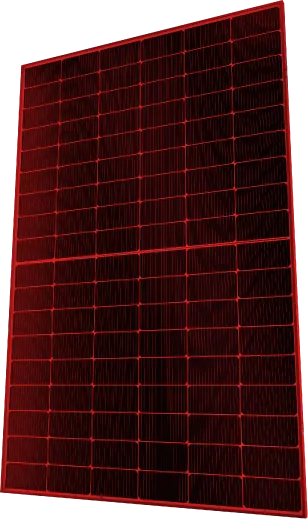
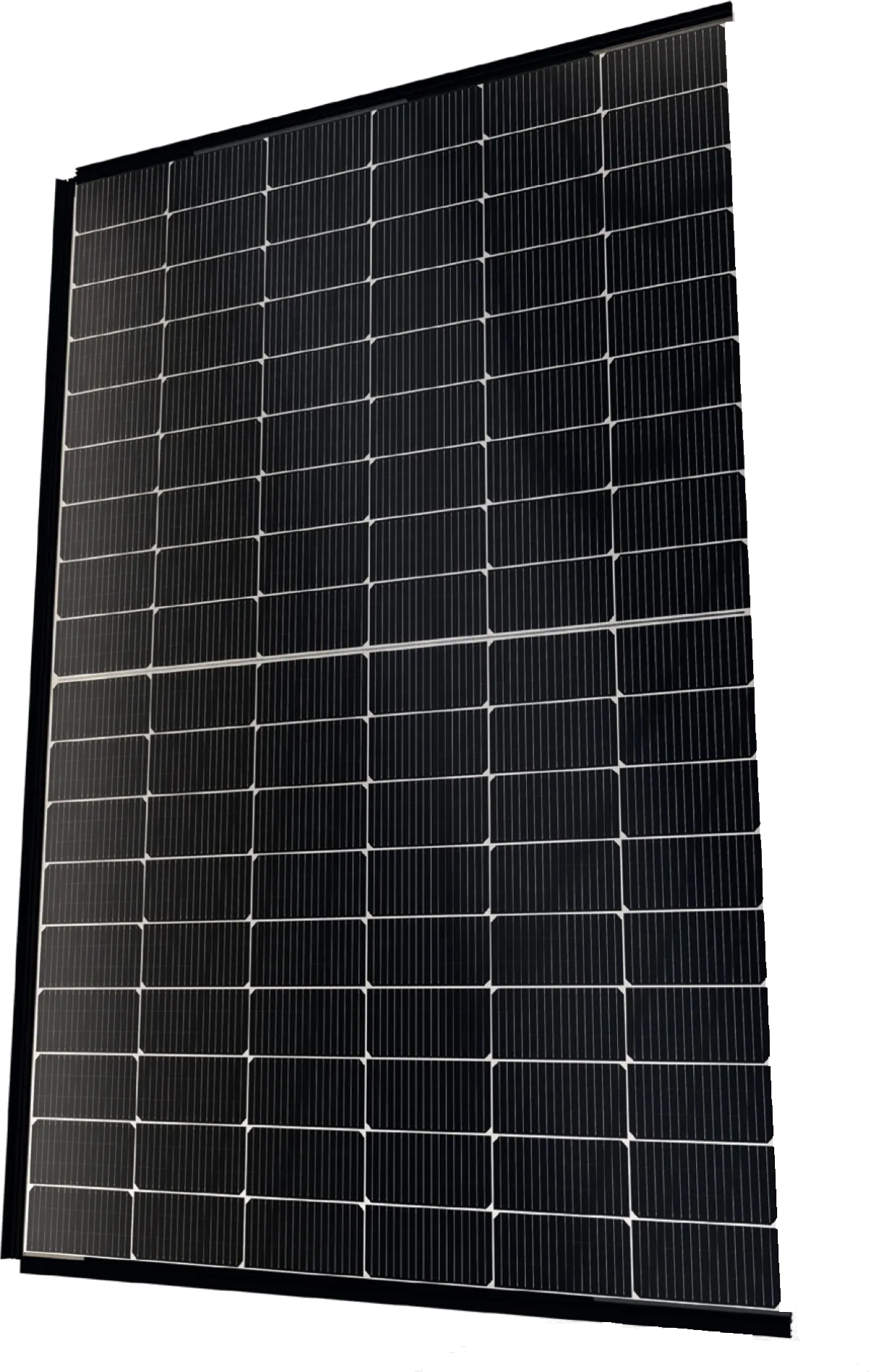
Monocrystalline TOPCon silicon photovoltaic module: 390 Watt, 108 cells. PRISMA 4.0 technology: 4 mm internal prismatic glass, front POE polymer with a density of 430 g/m³, transparent backsheet, red frames. Dimensions 1722x1134x35 mm, weight 24 kg, static load resistance 750 kg/m², hail resistance 45 mm at 110 km/h. 30-year warranty on manufacturing defects and 30-year linear performance warranty. Class 1 fire reaction, Class E certified, Broof (t2).
Circuit efficiency
Product warranty
IRSf · Static Robustness Index
Technologies used
High-efficiency TOPCon cells
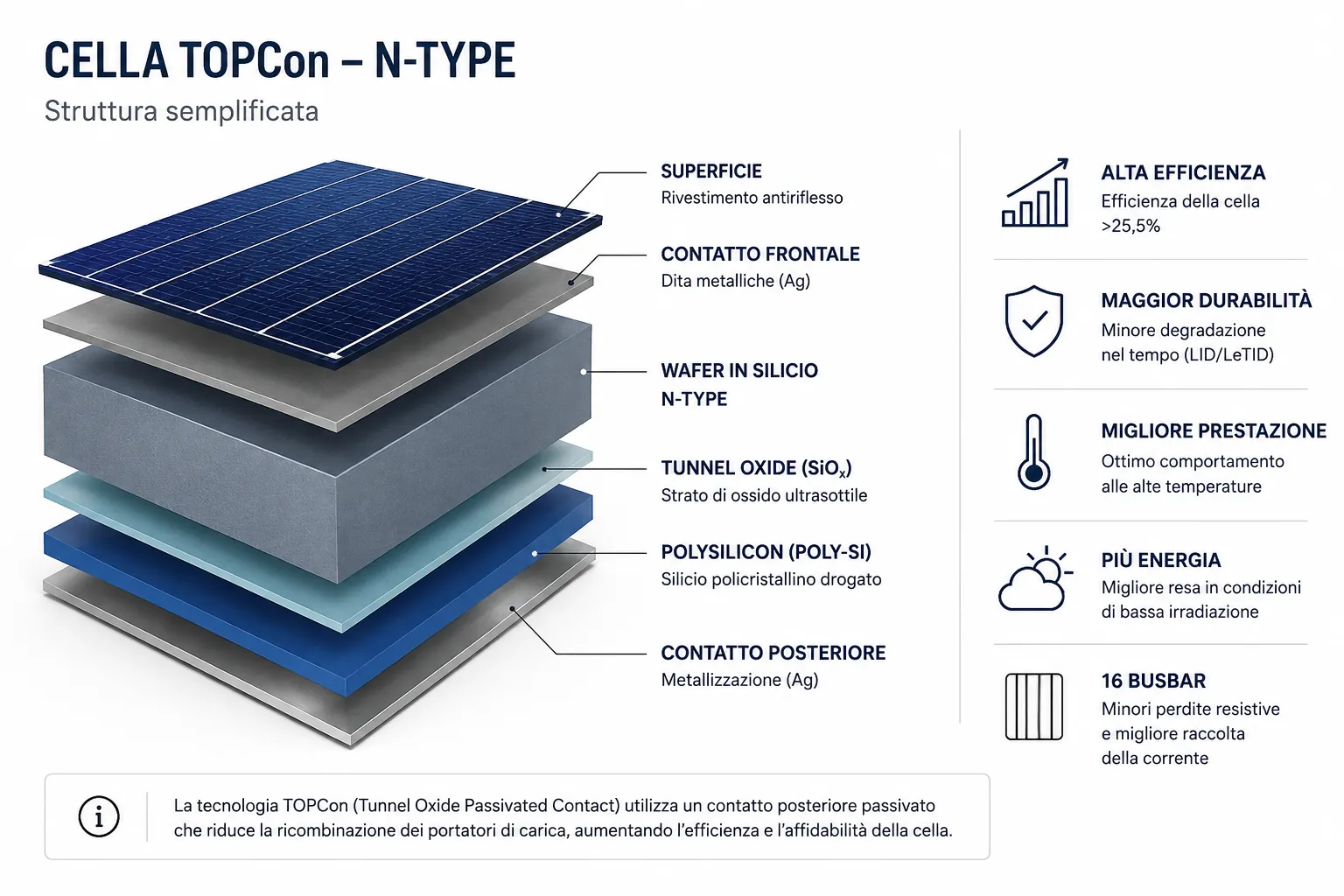
TORRI modules use the latest-generation N-Type TOPCon (Tunnel Oxide Passivated Contact) cells.
TOPCon technology introduces a very thin layer of silicon oxide and a passivated polycrystalline silicon contact on the back of the cell, reducing charge carrier recombination and therefore internal electrical losses.
Compared with previous PERC technologies, it allows higher conversion efficiency, better behaviour at high temperatures, greater response in low-irradiance conditions and less degradation over time.
ARC — Anti-Reflective Coating
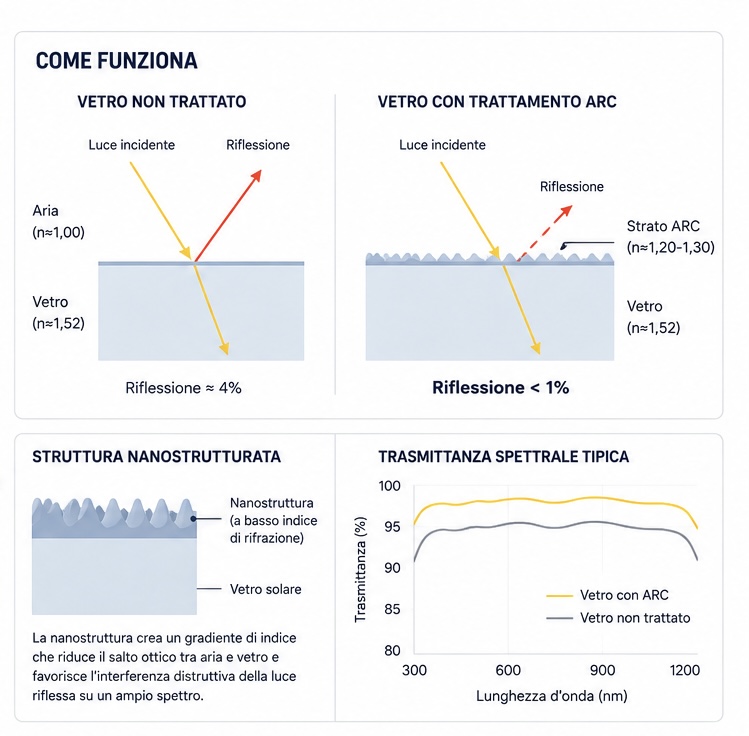
The front glass is treated with a nanostructured ARC anti-reflective coating, designed to increase the transmittance of solar radiation towards the cells.
The coating creates a layer with a refractive index intermediate between air and glass, reducing the index jump at the interface and therefore the optical losses due to reflection according to Fresnel's laws.
The structure and optical thickness of the coating are also designed to generate destructive interference between the components of reflected light, further decreasing reflectance at the wavelengths relevant to photovoltaic conversion.
The result is greater solar transmittance of the glass and an increase in the photon flux incident on the cells, with a reduction in the module's optical losses.
Complete datasheet
Hail resistance — IEC 61215 MQT 17
The hail resistance of a photovoltaic module is verified through controlled impact tests in accordance with IEC 61215-2 – MQT 17 Hail Test.
The test uses ice balls of defined diameter and mass, accelerated to a preset speed and directed at specific points of the module. It therefore evaluates not only the size of the hailstone: the fundamental physical parameter is the kinetic energy transferred during impact, determined by mass and, above all, by the square of the speed:
Test levels and impact energy
| Diameter | Mass | Speed | Kinetic energy |
|---|---|---|---|
| 25 mm | 7,5 g | 23,0 m/s | ≈ 2,0 J |
| 35 mm | 20,7 g | 27,2 m/s | ≈ 7,7 J |
| 45 mm | 43,9 g | 30,7 m/s | ≈ 20,7 J |
| 55 mm | 80,2 g | 33,9 m/s | ≈ 46,1 J |
| 65 mm | 132 g | 36,7 m/s | ≈ 88,9 J |
| 75 mm | 203 g | 39,5 m/s | ≈ 158 J |
Why impact energy matters
The base level of 25 mm subjects the module to about 2 Joules. As the hailstone diameter increases, the rise in severity is not linear: a 55 mm ball reaches about 46 Joules, over 23 times the kinetic energy of the 25 mm test. With a 75 mm ball it reaches about 158 Joules, almost 80 times the energy of the base level.
For this reason, knowing only the diameter of the hail is not enough to assess a module's resistance: diameter, mass, speed and impact energy must be considered together.
What is stressed during impact
The impact does not affect the glass alone. The energy is transferred through the entire module structure and can cause:
- —breakage or damage to the front glass
- —microcracks and cell fractures
- —damage to the interconnections
- —local deformation of the laminate
- —loss of insulation or deterioration of the electrical characteristics
This is why TORRI works on the module's resistance as a complete system: 4 mm front glass, laminate structure, high-density encapsulation and mechanical protection of the cells all contribute to the panel's ability to dissipate the energy generated by the impact.
Hail resistance is therefore not just glass resistance: it is the resistance of the entire architecture of the photovoltaic module.
*We define all our products through circuit efficiency, an index we developed to relate the maximum cell efficiency to the size of the photovoltaic panel in order to achieve the best thermal performance.
**STC (standard test conditions) - 1000 Watt/m², AM 1.5, 25°C
***PPS (Product/Performance/Service) - Warranty reserved for partners covering the labour required for the possible replacement of defective products for the first two years.
****Factory Inspection is not available for all products; please ask the sales office before purchase.
Technical specifications are subject to continuous updates and may change at any time without notice. Please verify warranty conditions and validity directly with the company at the time of purchase.
Documentation
Datasheet
PDF · Integra Eco-Red
Product documents
Browse the list. Downloads are reserved to the Customer Area.
Manuale
Moduli Fotovoltaici · PDF · 1.2 MB
Garanzia sui moduli fotovoltaici
Moduli Fotovoltaici · PDF · 581 KB
IEC 61215/ IEC 61730 mono
Moduli Fotovoltaici · PDF · 316 KB
IEC 61215/ IEC 61730 poli
Moduli Fotovoltaici · PDF · 326 KB
Reazione Fuoco: CLASSE 1
Moduli Fotovoltaici · PDF · 748 KB
Certificazione al fuoco BROOF T2
Moduli Fotovoltaici · PDF · 815 KB
Certificazione al fuoco EN 13501 1 CLASSE E
Moduli Fotovoltaici · PDF · 804 KB
Conformità RoHS
Moduli Fotovoltaici · PDF · 5.7 MB
Dichiarazione conformità CE
Moduli Fotovoltaici · PDF · 579 KB
Relazione UniBs - Test grandine
Certificazione · Moduli Fotovoltaici · PDF · 1.4 MB
All documents in the Customer Area
Log in to the Customer Area to download all product documentation: datasheets, manuals, certifications and warranties.


IRS · Static Robustness Index
+ material = + resistance to external factors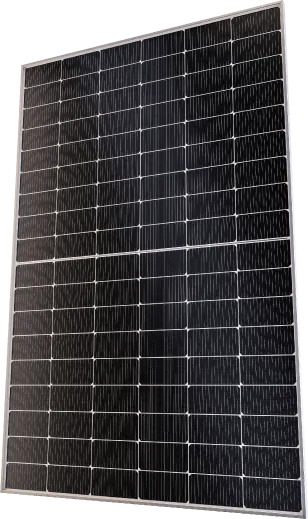
Request information about Integra Eco-Red
Would you like to know more about this product, get a quote or talk to a technician? Fill in the form: we'll get back to you with all the details.